Drive from Samsung
Twin joysticks, camera feedback and a stop control in a custom Android app. Manual control uses an existing local Wi-Fi network; it does not need an Internet connection.
A six-wheel rover. A Samsung controller. A project that connects software to movement.
Try the browser simulation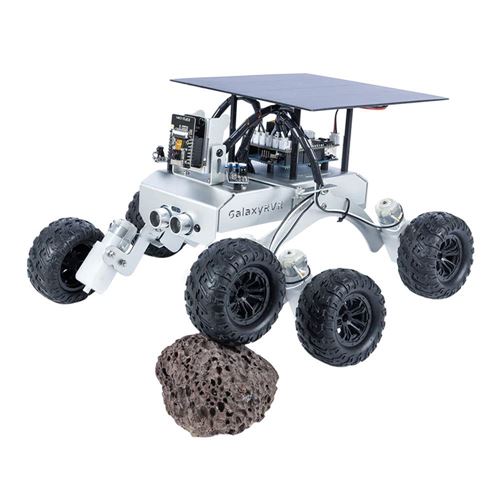
The custom project builds on SunFounder’s kit: a rocker-bogie chassis, UNO/R3 motor controller, ESP32 camera, ultrasonic and infrared sensing, and solar-assisted charging.
Explore the original hardwareTwin joysticks, camera feedback and a stop control in a custom Android app. Manual control uses an existing local Wi-Fi network; it does not need an Internet connection.
The phone passes a voice command to a Mac controller. A hosted JEV model selects an approved movement script, and the controller checks and sends it to the rover. Voice selection needs Internet access.
The project records camera frames, sensor readings, commands and acknowledgments. Saved-route and replay tools are implemented; repeatable physical navigation remains under validation.
Project records confirm an onboard timed movement command and a returned stop acknowledgment. Exact turn angles and repeatable autonomous routes are still being validated.
This separate EPICS booth concept simulates two rovers sharing a controller. Take ownership of Rover 1, use the direction buttons, then try the emergency stop. A simulated 500 ms watchdog stops motion after a command expires.
Browser simulation only. No physical rover, camera or private controller is connected. Positions, ownership, timing and latency values below are fictional.
| Process variable | Rover 1 | Rover 2 |
|---|---|---|
| ROVER:n:OWNER | - | - |
| ROVER:n:CMD | stop | stop |
| ROVER:n:WDOG (ms) | - | - |
| ROVER:n:LATENCY (ms) | - | - |
| ROVER:ESTOP | clear | |
Illustrative EPICS names and simulated values. This example runs entirely in your browser.